
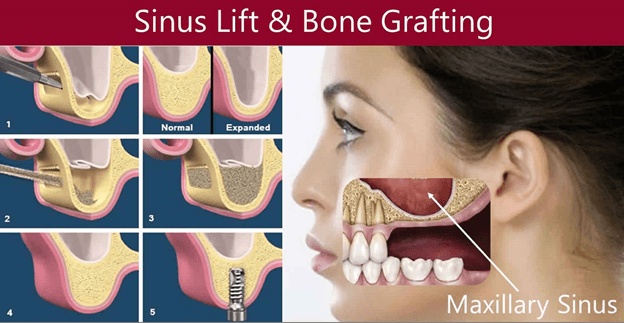
The maxillary sinuses are air-filled cavities located in the cheekbones just below the eyes. Tooth loss below the sinus leads to bone loss, and over time the sinus expands into the area previously occupied by bone and teeth. When the sinus wall is very thin, it is impossible to place dental implants in this bone. There is a solution and it’s called a sinus bone graft or sinus lift.
Sinus Lift procedure
In this common procedure, we enter the sinus from where the upper teeth used to be. The sinus membrane is then lifted upward and bone/bone substitutes are inserted into the sinus.
If enough bone between the upper jaw ridge and the bottom of the sinus is available to stabilize the implant well, sinus augmentations and implant placement can often be performed as a single procedure.
If the bone is very thin, the sinus bone graft will have to be performed first, and then the graft will have to mature for a few months, depending upon the type of graft material used. Once the graft has matured, the implants can be placed
The sinus graft makes it possible for many patients to have dental implants when years ago there was no other option other than wearing loose dentures.
If you are in need for a sinus lift surgery, Contact us today!
FAQs About Sinus Lift Surgery
Q1. Why is a sinus lift needed before dental implants?
A sinus lift is needed when the bone of the upper jaw becomes too thin to support dental implants, creating enough bone height for a stable, long-lasting implant.
Q2. Is a sinus lift a serious surgery?
Sinus lift surgery is a safe, routine dental procedure, performed by specialists in Delhi, designed to strengthen the upper jaw for successful dental implants.
Q3. How painful is sinus lift surgery?
With local anesthesia and modern techniques, sinus lift surgery is almost painless. Patients may feel mild swelling or discomfort, which can be easily controlled with prescribed medications.
Q4. Is a sinus lift expensive?
Sinus lift surgery is considered an affordable, long-term investment, as it ensures stable dental implants and prevents complications caused by inadequate bone support.
Q5. What is the success rate of a sinus lift?
Sinus lift surgery has a success rate of over 90-95%, making it a reliable solution for patients requiring dental implants in the upper jaw.
Q6. How much does a sinus lift cost in India?
The cost of sinus lift surgery in India usually ranges from ₹25,000 to ₹60,000, depending on the clinic, specialization, and graft material used.
Q7. Does a sinus lift affect your breathing?
No, sinus lift surgery does not affect breathing. The procedure only involves raising the sinus membrane slightly to make room for bone grafts and dental implants.
Q8. What to eat after sinus lift surgery?
After sinus lift surgery, patients should eat soft foods such as soups, mashed potatoes, smoothies, and yogurt, and avoid crunchy or spicy foods for faster healing.
Q9. What are the risks and complications of sinus lift surgery?
Risks include rupture of the sinus membrane, mild infection, or temporary swelling. Choosing an experienced dentist in Delhi reduces complications and ensures smooth recovery.
Q10. Do I need both sides of my sinus lift surgery?
Bilateral sinus lift surgery is only needed if dental implants are necessary on both sides of the upper jaw. Otherwise, a single-side lift may be sufficient.
Q11. Can I avoid sinus lift with short dental implants?
In some cases, small dental implants may eliminate the need for a sinus lift, but long-term stability is usually better with proper sinus lift surgery.
Q12. Is sinus lift surgery safe for older patients?
Yes, sinus lift surgery is safe for older patients, provided they are medically fit. It helps to provide jawbone support for durable dental implants at any age.
Q13. Can sinus lift surgery cause sinus infection?
Occasionally, sinus lift surgery may cause temporary sinus infections, which can be treated with antibiotics. Proper care and skilled surgery minimizes this risk.
Q14. Is sinus lift permanent?
Yes, sinus lift surgery provides permanent bone support for dental implants. Once healed, the implanted bone fuses naturally, ensuring long-term stability and durability of the implant.