
Root Canal Treatment (RCT): A Complete Patient Guide with Cost Details
Root Canal Treatment commonly called as RCT is a commonly performed procedure in dental clinics.
When does a dentist recommend RCT?
- RCT is recommended to relieve symptoms of pain or severe sensitivity to hot/cold in teeth.
- In teeth affected by decay where the decay reaches the pulp tissue (whether accompanied by pain or not).
- Where tooth is badly infected.
- In cases of tooth fracture or trauma involving the pulp tissue.
- A discolored tooth whether accompanied by pain or not.
What does a Root Canal Treatment Procedure Involve?
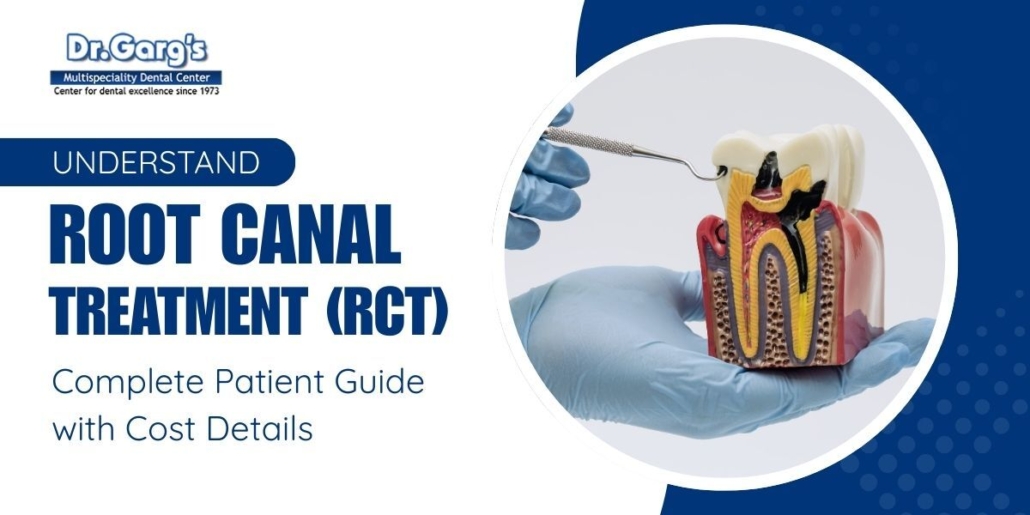
Every tooth has a vital portion called the dental pulp which houses the nerves, vein and arteries inside the tooth. It is housed deep within the tooth protected by the tooth structure. When this pulp tissue becomes exposed to outer environment due to decay or trauma, it might cause pain.
In RCT, this vital dental pulp tissue is removed and replaced by inert filling material. This removes the cause of pain leaving the tooth to function. It can be performed both in children and adults.
Is Root Canal painful?
No, Root Canal is performed under local anesthesia and is not at all painful.
How long does a Root Canal procedure take?
Today, most root canal treatment are performed as a single sitting procedure needing about 45 min to 1 hour.
What is the cost of root canal procedure?
The cost of an RCT can vary depending on
- The type of tooth: Anterior teeth have single canal and better access for treatment. Comparatively, Molars can have 3 to 4 root canals with a very limited access. So molar RCTs tend to be expensive than anterior tooth root canals.
- Complexity of case: Not all cases even in the same tooth have same difficulty level. Some can be extremely difficult depending on age of patient, patient cooperation, degree of mouth opening etc.
- Quality of materials used for the procedure: Using rotary files, apex locator and laser increases the cost of the procedure but at the same time also increases the efficacy and success rate of the procedure
Experience of the treating doctor. An experienced Indian RCT dentist would definitely charge more than a novice but will give you predictable results.
Post – operative care after RCT
- RCT procedure relieves pain immediately after the procedure but the involved tooth might be sensitive to pressure for few days. So the patient is advised not to chew on the treated tooth for at least 3 days.
- An antibiotic and a pain killer is prescribed for 3 days post operatively.
- Getting a crown over a RCT treated tooth is a must to preserve the tooth and to prevent fracture.
Briefly stated, a Root Canal Treatment is a predictable and efficient way to save a tooth affected by tooth decay or fracture. It is the only way to save a tooth which otherwise would need to be removed. Not only the procedure helps to preserve form and function but at the same time saves you from expenses of time and money arising out of replacement of a tooth by dental implant.

Leave a Reply
Want to join the discussion?Feel free to contribute!